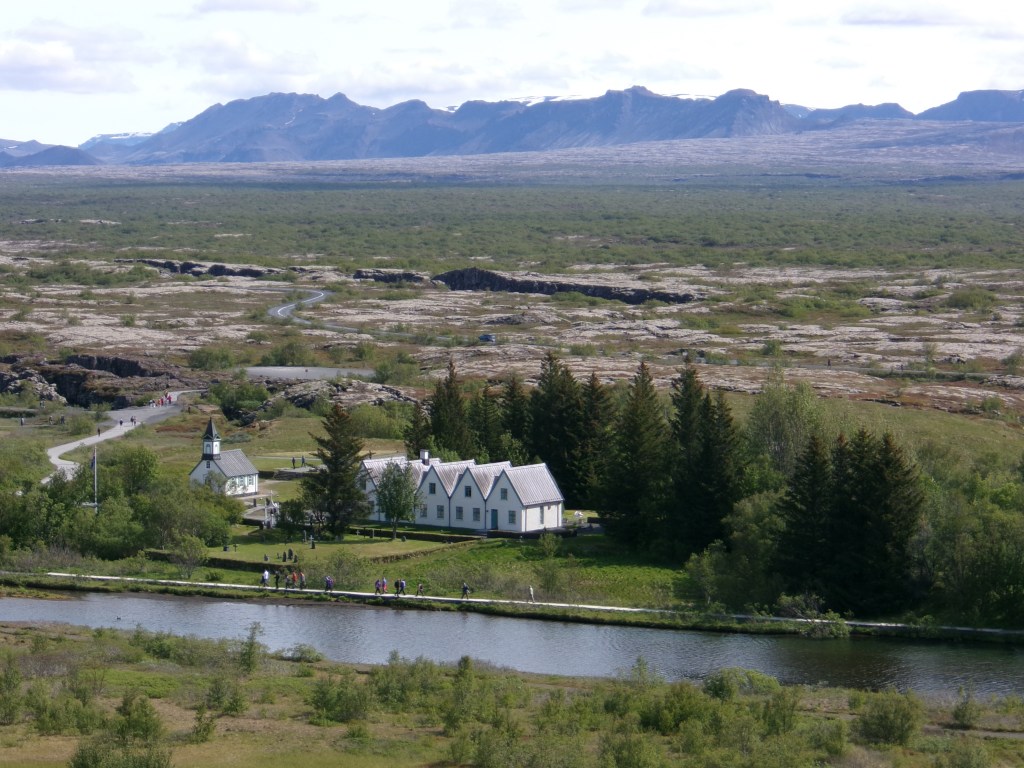
Iceland – known for its breathtaking landscapes and winter Northern Lights, but it’s a country just as incredible to visit in the summer months, when the sun never fully sets. In early June, I had the incredible opportunity to visit Iceland as part of my school’s Global Initiatives trip to learn about Climate Change and Human Geography in the Land of Fire and Ice.
The trip was only for eight days, and with our limited time, we started in Reykjavik and traveled mostly around the south coast of the island. But we made the most of our time, sometimes visiting up to 5 spots a day! Each day was jam-packed with activities, sightseeing, good eats, and more. We set off every morning at 9 a.m., listening to our tour guide explaining Iceland’s history, its geology, fun facts, and sagas. Did you know that Iceland has one of the highest numbers of Nobel Prize winners? That is, per capita, of course! (They have one!)
And oh, was it an amazing experience! I was genuinely awe-struck by all of Iceland’s natural beauty, and each new spot we visited seemed just as incredible as the last. It genuinely felt out of this world, especially with its wide variety of geological wonders — volcanoes, glaciers, waterfalls, and geysers — that gives the island its fairytale-like quality.
So, here are my top 10 places I loved visiting while in Iceland (as I mentioned, in the south of the island). As it has become much more of a tourist destination in the past few years, you definitely won’t want to miss these!
1. Thingvellir National Park
Starting off with this national park and historic site located just east of Reykjavik, it encompasses 240 square kilometers of beautiful landscapes and unique geological features — there’s a lot of space to walk around. But it’s not just the views that make it special — it’s also located in a rift valley between the Eurasian and North American tectonic plate boundaries. Thingvellir is the only place in the world where you can walk between two tectonic plates. What’s more, they’re still actively separating at a rate of about 2 centimeters per year!
Thingvellir is also an important fixture in Iceland’s rich history. From the year 930 until 1798, it was the annual meeting place for the Althing general assembly, which is the world’s oldest existing national parliament. Thus, it was the site of many important events, such as the adoption of Christianity as Iceland’s national religion over paganism. Chiefs attending the assembly also had their own booths, temporary living spaces made of turf and boulders and covered with twill. Now, only grassy rectangular indents are the remains of where the booths used to be located.

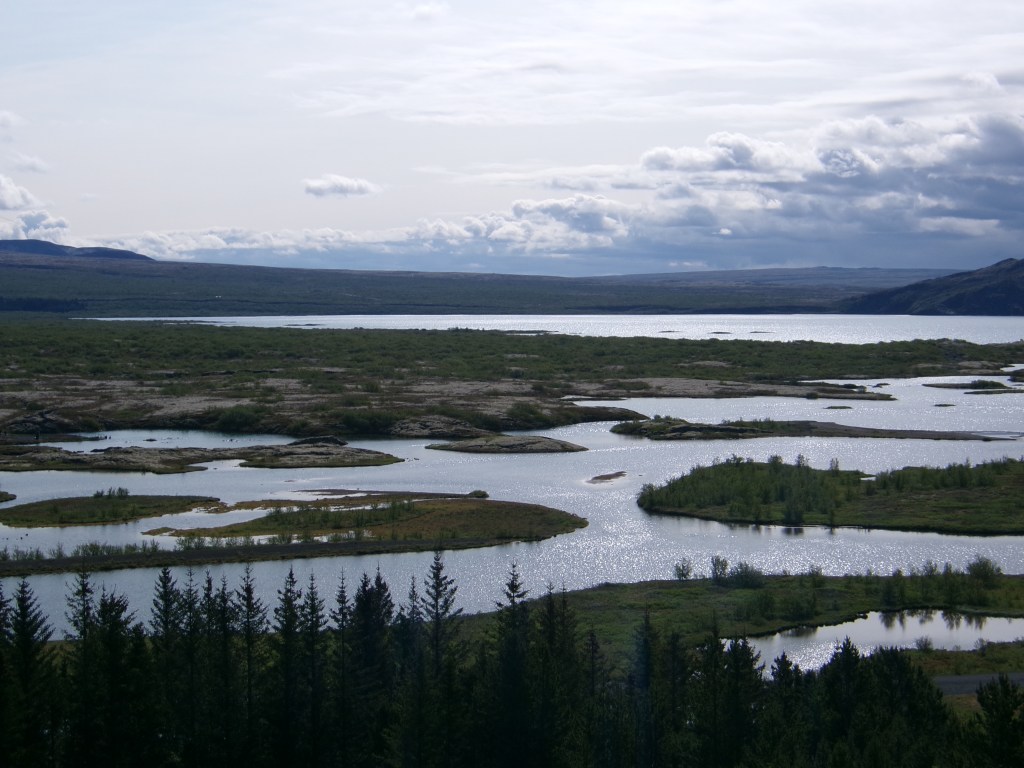
Thingvellir was also the site for many executions, including at this small pool pictured above. While a beautiful location, it was used to drown women who gave birth to children out of wedlock, earning it the nickname of the ‘Drowning Pool.’

On a happier note, we also stopped by this pool, where many visitors before us had thrown coins into it. The water was so clear, I could see everything beneath the surface, and the coins added a shiny, glittery effect.
Thingvellir National Park, with not only its beauty but also its historical and geological importance, is definitely a worthwhile stop on any Iceland itinerary.

2. Vínstofa Friðheima
Less than a 45 minute drive from Thingvellir is a restaurant called Vínstofa Friðheima, which translates to Friðheimar Wine Bar & Bistro. I’m including it on this list simply because it is probably the most beautiful restaurant I’ve been to in my whole life. It’s located inside a greenhouse covered in grape plants, and the whole area is covered with plants and flowers.
Since my school group had a lot of people, we ate in the alcove at the back of the restaurant. The entrance to the alcove was covered in books on shelves, and it was such a nice touch!

As for the food, they served us tomato soup and generous amounts of bread and butter. It was delicious, especially after learning they grew their own tomatoes on-site. We toured the next-door greenhouse and saw the plants and fresh bread selection. They even had horses on the farm that someone was riding!

Overall, I loved the atmosphere and the food and I’d definitely recommend making a stop here.

3. Gulfoss
In Icelandic, foss means waterfall. Gulfoss, aka ‘Golden Waterfall,’ is a site guaranteed to take your breath away. As part of the Golden Circle route, along with Thingvellir National Park and the Geysir geothermal area, it’s no surprise that it’s one of Iceland’s most popular tourist attractions.
Gulfoss originates from the Hvítá river, which is in turn fed by meltwater from Iceland’s second-largest glacier, the Langjökull glacier. It’s a two-tiered waterfall, with its two drops totalling around 105 feet. The water then cascades into a deep canyon.
While walking down the steep cliff from the upper viewing area, Gulfoss begins to look even more majestic. The lower platform brought me right next to the start of the falls. Seeing Gulfoss up close and hearing its powerful rush of water made for an unforgettable experience (and a perfect spot for photos!). It’s definitely a must-see!

4. Geysir
The Geysir Geothermal Area is another stop on the Golden Circle. The trails through the area lead past small hot springs and geysers that, due to the hydrogen sulfide gas in the air, smell strongly of rotten eggs. But, the main event is the Strokkur geyser, which erupts predictably every 5 to 10 minutes.
When I visited, the geyser erupted every eight minutes, and there was a large crowd gathered around it. As time neared the mark, everyone around me had their phones out to capture the exciting moment. Strokkur is approximately 12 meters in diameter, so it was very large, and when it erupted, a huge jet of water shot up out of it. While it usually erupts to a height of 15-20 meters, it can sometimes achieve a height of 40 meters.

The geothermal area is also home to the Great Geysir, its namesake, but unfortunately I did not get the chance to see it. However, it’s now mostly dormant, as its last eruption was in 2016.

5. Seljalandsfoss
Yet another waterfall, the 60-meter Seljalandsfoss is amazingly picturesque. It’s probably one of my favorite views from the trip. Surrounded by greenery and cliffs, it looks like it was pulled straight from the pages of a fantasy novel.
The path wraps behind the falls, allowing visitors to uniquely experience it from inside a cave in the cliffs. From there, the view was unlike anything else; just the cave behind me, the wall of rushing water in front, and the roar of the waterfall echoing around, spraying mist down on us.
My friend and I climbed down to the base of Seljalandsfoss, and it felt unreal! The water was just feet away from me, soaking me from head to toe. It had definitely been a good idea to wear my rain gear!
Just a note: I’ve read that in the winter, the path behind the falls is often closed due to potentially icy and dangerous conditions.

6. Westman Islands
The Westman Islands are a set of 15 islands off the south coast of Iceland, nicknamed “Pompeii of the North.” The island we visited, Heimaey, is the only one that is inhabited, with a population of approximately 4,500 people.
Our tour guide told us about the history of the islands and its name. ‘Westman’ refers to early Icelanders’ Irish slaves, who were referred to as such because Ireland is to the west of Scandinavia. When they gained their freedom, the Islands were named after them.
Our ferry journey to the islands was cold and windy, but it was so cool to watch them slowly emerging from the fog in front of us. We landed in the town of Vestmannaeyjabær, and seeing the other islands from the ferry was mesmerizing. It seemed that they had been carved so precisely and intricately on the sides of the cliffs, and it was very striking.

Our tour guide informed us that one-third of the town is in a lava field, a result of the 1973 eruption of the volcano Eldfell. The eruption continued for almost six months, causing an evacuation of the island and the destruction of many homes.
The hike to the top of Eldfell was treacherous, marked by a steep incline and red-colored oxidized iron covering the volcano. There was fog everywhere, so we couldn’t see how far a tumble down would be. Fortunately, it cleared up rapidly, resulting in an astonishing view of the island that was well worth the perilous journey.

The Westman Islands are also famous for their large puffin population (a total of 10 million during the summer months!), which attracts many visitors and has made it one of the best places to see puffins in Iceland. The island houses a Beluga Whale Sanctuary and Puffin Rescue Centre, but there is an admissions fee; instead, I went with half of my school group to find puffins in the wild.
We took a 1.5 mile walk out to Elephant Rock, which became one of my favorite sights on the trip. The water was a brilliant turquoise, and there were cliffs all behind us and the Atlantic Ocean before us. We were also standing by the 17th hole of a golf course, which was interesting. I kept imagining what it would be like to play on a course with views like that!
We saw the puffins — not up close, since they make their nests high up in the cliffs, but they flew above us. We could only distinguish them by their very rapid wingbeats.
With its history, wildlife, and incredible scenery, the Westman Islands were one of my favorites on this list — a must-visit, capturing so much of the magic of Iceland.

7. Reynisfjara Beach
Unlike the U.S., the majority of Iceland’s beaches are black sand. The most famous is Reynisfjara, located near the town of Vík. The ‘black sand’ on the beach is actually finely ground-up basalt, which eventually gives way to smooth, marbley pebbles. There is also a huge wall of basalt columns towering along the cliffs of the mountain, which a few people climbed on. The hexagonally-shaped rock formations are created by lava cooling and contracting, causing cracks that naturally form the geometrical patterns.

The beach was beautiful, especially from the caves tucked into the cliffs, where the basalt columns reached even to the ceiling. And a couple days later, we got to experience the view from above — waves crashing on the curving black shoreline — which was just as breathtaking.
But while it’s calming to watch the waves, they also contain danger within them. Our tour guide had told us about the strong waves and current, which had previously swept several unsuspecting tourists out to sea. Nevertheless, Reynisfjara’s incredible scenery and views make it a true highlight of my trip.

8. Fjallsárlón Glacier Lagoon
Located on the southern end of the large Vatnajökull glacier, Fjallsárlón is a glacier lagoon containing hundreds of icebergs. My group took two Zodiacs, a type of inflatable boat, out on the water. We sailed out to the glaciers, looking at them up close.
It’s amazing to think about the scale of these glaciers — especially since 90% of them lie below the surface. The meager 10% of a glacier that we do see really is just the tip of the iceberg (haha).
Some of the glaciers already looked huge above the surface, and yet, they are melting so rapidly. Because of different temperatures, parts of the glacier above and below the surface do not melt at the same rate. Since the water in the lagoon is extremely cold, icebergs melt faster above the surface. In order to maintain its 10%-90% balance, the glacier then rises and moves around. As they’re rising, sometimes they will even rise enough to flip over.

Our Zodiac driver taught us about the blue-colored ice on the bottoms of some glaciers. He said that we were lucky to see it, because it occurs when glaciers rise, and the blue ice we see has not yet been exposed to the sun. The ice is actually clear, but blue light absorbs and reflects it, giving it its color. After only 2-3 hours of sunlight exposure, the ice will start to crack, allowing air back inside and effectively turning the ice white.
We also learned that the glaciers in Iceland are rapidly shrinking, but at different rates. The driver mentioned that some are shrinking by several feet per week, and others by several feet per day — you can literally see them in the morning and evening of the same day and spot the difference.
Learning about the glaciers gave me a greater appreciation for them and how climate change is affecting them. Sailing on the lagoon and seeing them up close was a great experience, allowing me to see the effects right before my eyes.

9. Diamond Beach
Unlike its name suggests, this beach located close to Fjallsárlón is not actually covered in diamonds. But it is covered in icebergs that wash ashore from the nearby Jökullsárlón Glacier Lagoon. These chunks break off from the large glacier and are shaped by the sea, forming each one into a different shape and size. One even looked just like a goose or swan! Scattered all across the black volcanic sand, the icebergs really do make the beach look like it’s sprinkled with diamonds.
When I visited Diamond Beach, the sky was cloudy, but I can imagine it during a nice sunset or when the sun is shining, and light bounces off the ice! Even so, it was still a beautiful stop — definitely worth a visit.

10. Reykjanes Peninsula
If you look at a map of Iceland, the Reykjanes Peninsula in the southwest region makes up the “boot” of the island. Situated on the Mid-Atlantic Ridge, the peninsula is a geologically active landscape with lava fields, geothermal areas, and more. We visited the lava fields, viewing the two different types of lava — ʻa‘ā and pāhoehoe — covered in moss. (The trick to remembering the difference is that ʻa‘ā lava is very rough, and if you step on it with your bare feet, you would say, “Ah ah!” Meanwhile, pāhoehoe lava is a smoother, ropy lava.)


We got to climb down to the inside of a lava tube, which was pretty cool. It’s red inside from the oxidized iron.

Then, we visited Reykjanes Nature Reserve, which measures 300 square kilometers of land. It contains Kleifarvatn Lake, the largest lake in the Reykjanes Peninsula, and a very beautiful spot. We learned that an episode of the TV show Black Mirror was filmed at this location.

From the lake, we took a quick drive to the Seltún Geothermal Area, another site filled with mud pools, hot springs, and the stinky smell of sulfur. It was very colorful, which we learned was caused by different types of minerals.

We then took a short hike down to the site of the 2021 Fagradalsfjall eruption. There was a large river, sort of, of lava flowing down from the shield volcano in the distance (pāhoehoe lava!). It was so cool, and we were able to walk on it in some places and see the distinct ropy lava texture.
The eruption is known as a “tourist eruption,” due to its relatively minor nature and the large number of people flocking to see it. We asked our tour guide how long lava needs to cool before you can walk on it, and he said only a couple of days. But it might still be dangerous if it hasn’t completely cooled beneath the outer layers. Luckily for us, several years had passed already!

What was especially intriguing was what we found on some of the pieces of lava — some were coated in a pale green ceramic glaze. They were also dotted with tiny green specks of peridot, a gemstone often found in volcanic and mantle rock.
The Reykjanes Peninsula is also home to the fishing town of Grindavík, where the Sundhnúkur volcano erupted eight times between December 2023 to April 2025. These eruptions caused an evacuation and the destruction of many homes. Because of this situation, the houses in the area are insured against volcanoes and natural disasters. While many residents strongly wish to return to their hometown, others are unsure and may choose to not buy their homes back.

For our last stop of the day, we visited Valahnúkamöl, passing by the Reykjanes lighthouse along the way. There is a high cliff overlooking the ocean, and on the side of another cliff we found pillow lava, which occurs when lava erupts underwater. The rapid cooling while in cold water causes it to be encased in a pillow-like shape.

There was also a statue in honor of the great auk, a large, flightless bird hunted for their meat, feathers, and oil. The last known pair was killed in 1844 by fishermen on the Island of Eldey, a small, uninhabited island that is viewable from Valahnúkamöl.

Our tour guide took us through a hole in some of the boulders into what he likes to call ‘Narnia.’ Climbing on the many boulders, we came out into a wide open space right by the ocean. It was so peaceful and very scenic. He said he’s been coming there since he was five years old.
The Reykjanes Peninsula is filled with many different landscapes and geological features — and it captures so many of the wonders of Iceland. Spending the day there was a great idea — it was the perfect way to end an unforgettable trip.


 Simply Adelle
Leave a comment